HW4 Problems
Problem 1 (35 pts)
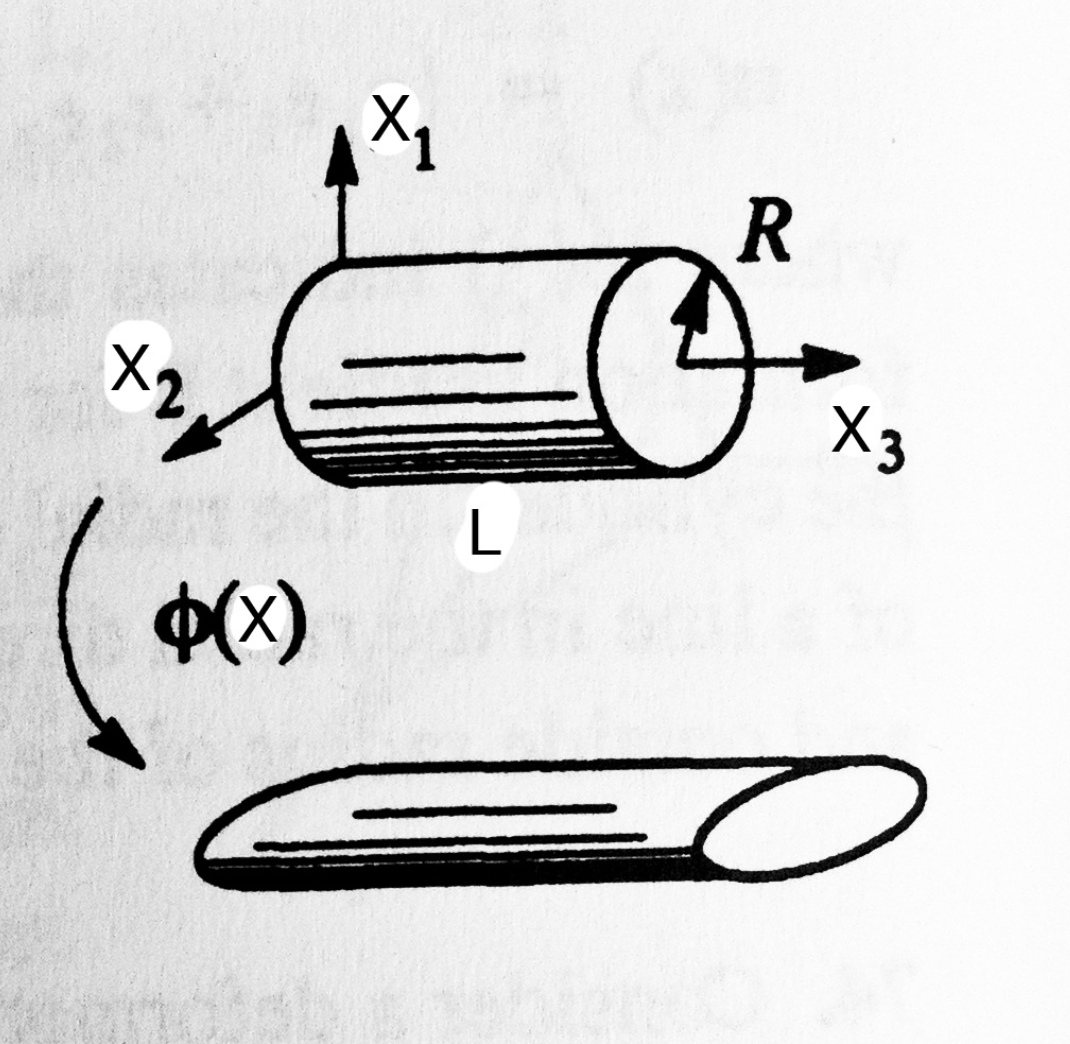
A circular cylinder of length L and radius R (Figure 1) undergoes the deformation characterized by \[ \bsf{x}[\bsf{X}] = \alpha X_{1} \bsf{E}_{1} + \beta X_{2} \bsf{E}_{2} + \gamma X_{3} \bsf{E}_{3} \] where \(\alpha, \beta\) and \(\gamma\) are constants. Find the total surface area of the deformed cylinder. What are the limits on the constants \(\alpha, \beta\) and \(\gamma\)?
Problem 2 (35 pts)
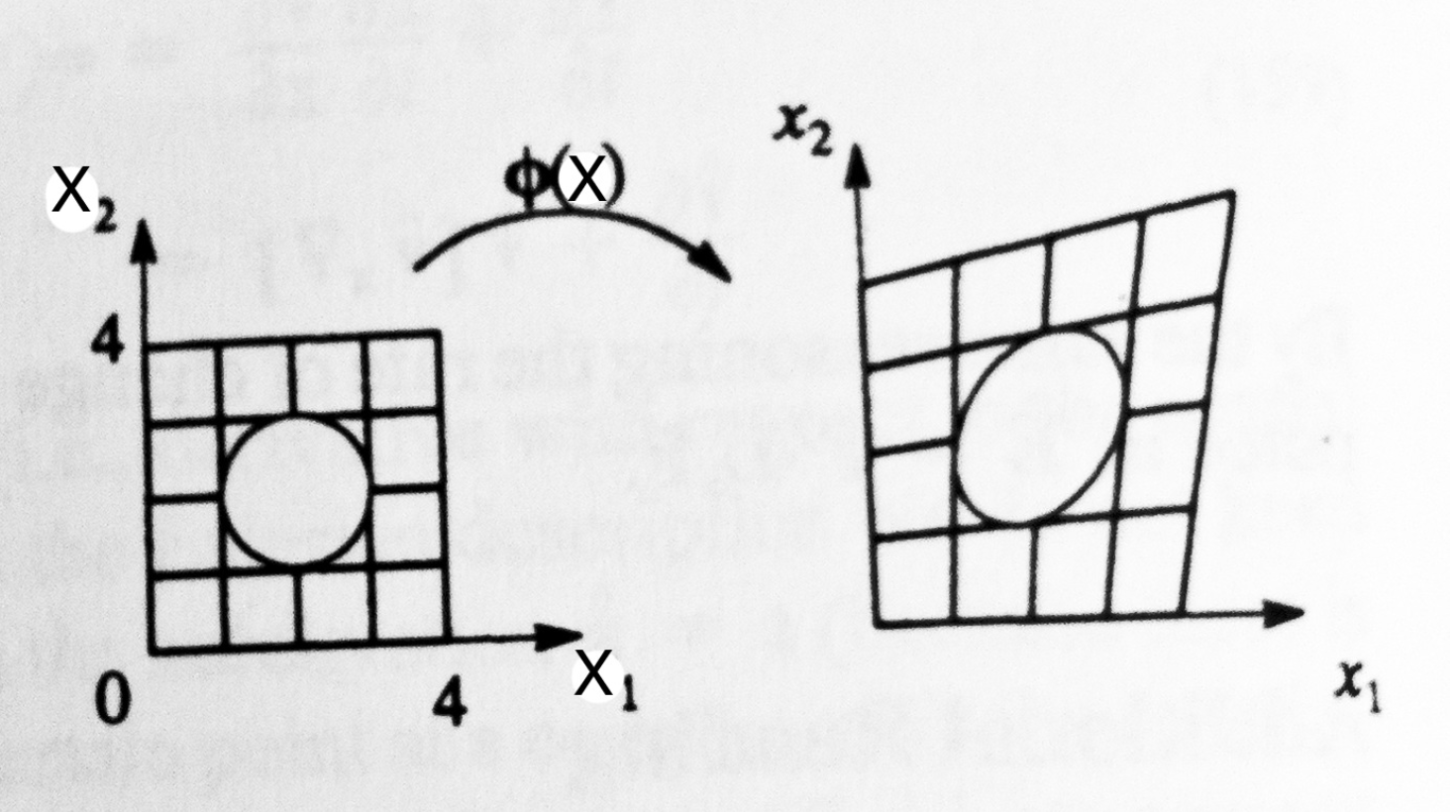
Consider a square piece of material of unit thickness with a round hole in it of radius 1 (see Figure 2). The material is subjected to the following deformation map: \[ \bsf{x}[\bsf{X}] = X_{1}(1 + \beta X_{2})\bsf{E}_{2} + X_{2}(1 + 3 \beta X_{1})\bsf{E}_{2} + X_{3} \bsf{E}_{3} \] Compute the volume of the hole in the undeformed and deformed configurations.
Problem 3 (30 pts)
Left \(\bsf{F}\) be invertible. The right and left polar decompositions of \(\bsf{F}\) are given by \(\bsf{F} = \bsf{R} \bsf{U}\) and \(\bsf{F} = \bsf{V} \bsf{R}\), where \(\bsf{R}\) is an orthogonal (rotation) map and \(\bsf{U}\) and \(\bsf{V}\) are positive semi definite maps, termed the right and left stretch tensors. Further, \(\bsf{U} = \sqrt{\bsf{F}^{\msf{T}} \bsf{F}}\) and \(\bsf{V} = \sqrt{\bsf{F} \bsf{F}^{\msf{T}}}\).
- (10 pts) Show that \(\bsf{U}\) and \(\bsf{V}\) have the same characteristic equation and therefore the same eigenvalues.
- (10 pts) Do they have the same eigenvectors? Show your work.
- (10 pts) Explain the physical meaning of your answers to the two previous questions. Compare the physical representation of \(\bsf{U}\) and \(\bsf{V}\).